When you decide to finally get rid of a stubborn wart, a painful verruca, annoying skin tag, mole or keratosis you will quickly find that there is no shortage of removal options. If you visit a high-street clinic, you are most likely to be offered cryotherapy (freezing it with liquid nitrogen) or a laser treatment.
However, ask a plastic surgeon or dermatologist, and they will frequently steer you toward a time-honoured, highly precise surgical technique: Curettage and Cautery (C&C).
While freezing and lasers get a lot of marketing attention, curettage and cautery is often the superior choice for clearing raised skin lesions quickly, thoroughly, and reliably. Here is a clinically sound look at why this straightforward procedure continues to be the gold standard.
What Exactly is Curettage and Cautery?
Unlike procedures that try to destroy a lesion while it is still attached to your body, Curettage and Cautery is a minor, two-step surgical procedure performed right in the clinic room under local anaesthetic.
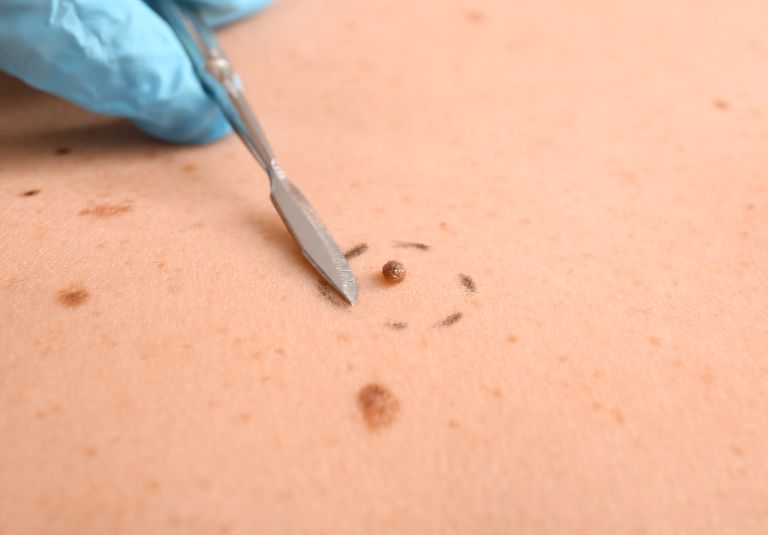
- Step 1: Curettage (The Scrape): After numbing the area completely so you feel zero pain, the doctor uses a small, spoon-shaped medical instrument with a sharp edge called a curette. Because abnormal tissue (like a viral wart or a skin tag) is structurally softer and more “friable” than healthy skin, the doctor can cleanly scrape and scoop the lesion away down to its base.
- Step 2: Cautery (The Seal): Once the lesion is removed, the doctor uses a precise, heated pen-like device (electrocautery) to lightly seal the base of the skin. This instantly stops any bleeding and—crucially—destroys any microscopic roots or viral cells left behind.
3 Reasons Why C&C Outperforms Cryotherapy and Lasers
While freezing or laser zapping sound highly modern, they carry biological limitations that frequently lead to patient frustration.
- The “One-and-Done” Success Rate
The biggest drawback of cryotherapy is that it is highly unpredictable. Liquid nitrogen relies on creating a localized frostbite blister to kill the tissue. Because the doctor cannot see how deep the freeze is going, they have to err on the side of caution. This is why cryotherapy frequently requires 3 to 6 separate sessions, spaced weeks apart, to completely clear a deep plantar wart (verruca).
Lasers face a similar issue: if the laser energy is set too low to prevent scarring, it won’t kill the deep viral cells.
The C&C Advantage: Because the doctor physically scrapes the lesion off during curettage and using magnification, the bulk of the problem is gone in seconds. The cautery step then physically cooks any remaining base cells. For most common warts, verrucae, and skin tags, Curettage and Cautery has a success rate of roughly 80% to 90% in a single, one-off session.
- Microscopic Proof: The Biopsy Advantage
When you treat a lesion with liquid nitrogen or a laser, the target tissue is either frozen to death or completely vaporized into ash. There is nothing left behind to test. While most warts and skin tags are completely harmless, certain rare types of skin cancers or pre-cancers can mimic benign growths.
The C&C Advantage: Because the curette cleanly separates the intact lesion from your normal skin, the doctor can place that tissue sample in a sterile vial and send it to a pathology lab for testing under a microscope. This gives you and your medical team absolute, biopsy-proven peace of mind that the growth was entirely benign.
- Precision Mapping (Zero “Friendly Fire”)
Cryotherapy is notoriously difficult to control. Liquid nitrogen is sprayed or applied via a cotton swab; it spreads in a circle, freezing the healthy skin surrounding your wart just as aggressively as the wart itself. This causes significant, painful blistering on healthy tissue and can leave permanent white rings (hypopigmentation), which is a major concern for individuals with darker skin tones. Lasers also carry a risk of “thermal scatter,” where heat bleeds into surrounding healthy skin cells.
The C&C Advantage: There is a natural, physical boundary line between abnormal tissue and your healthy skin. A skilled doctor can feel this boundary with the curette, effectively scooping out only the lesion while leaving the surrounding healthy skin untouched. The subsequent cautery is applied strictly to the tiny raw base left behind, minimizing the footprint of the eventual scar.
A Quick Overview: How They Compare
| Feature | Curettage & Cautery (C&C) | Cryotherapy (Freezing) | Laser Removal |
|---|---|---|---|
| Typical Sessions Needed | 1 session | 3 to 6 sessions | 1 to 3 sessions |
| Pain During Procedure | None (Fully numbed with local anaesthetic) | Moderate to severe burning/stinging | Mild to moderate stinging |
| Can Be Sent for Testing? | Yes (Preserves the tissue) | No (Tissue is destroyed) | No (Tissue is vaporized) |
| Recurrence Risk | Low (Physical removal + heat seal) | Moderate to High (Often leaves deep roots behind) | Low to Moderate |
What to Expect During Healing
After a C&C procedure, your local anaesthetic will wear off in a few hours, leaving the area feeling somewhat tender, similar to a mild burn or a skinned knee.
Because the skin is not cut deep enough to require stitches, the wound heals from the bottom up. Over the first week, it will form a hard, flat, reddish-brown or black crust. It is vital to let this scab fall off naturally to minimize scarring. Within 2 to 3 weeks, the surface will be replaced with fresh pink skin, which will gradually fade over the coming months into a flat, faint mark that closely matches your natural skin. You are advised to moisturise this scar.
If you are tired of over-the-counter liquids or multiple painful freezing appointments that fail to clear your lesions, ask a Plastic Surgeon if curettage and cautery is the right step forward for your skin.
Back to blog